










Win attention from busy people. With serious games.

Training and comms often get skimmed or skipped. But not when they’re a competitive challenge that people choose to engage with.

No download, no login, any device.

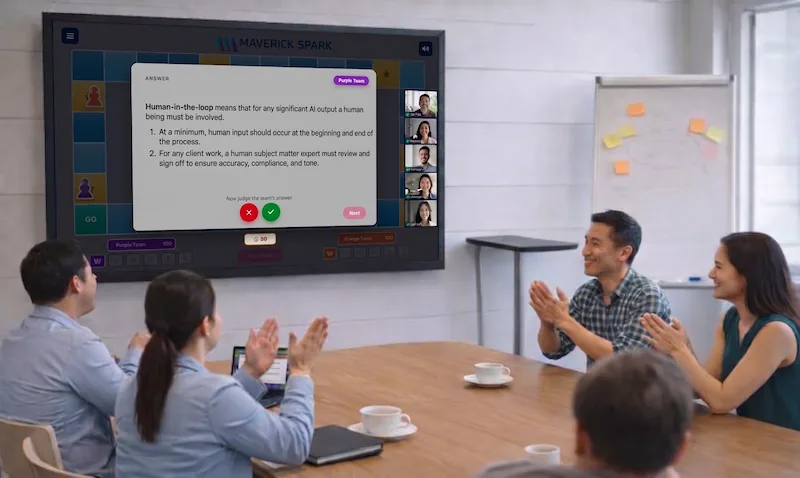
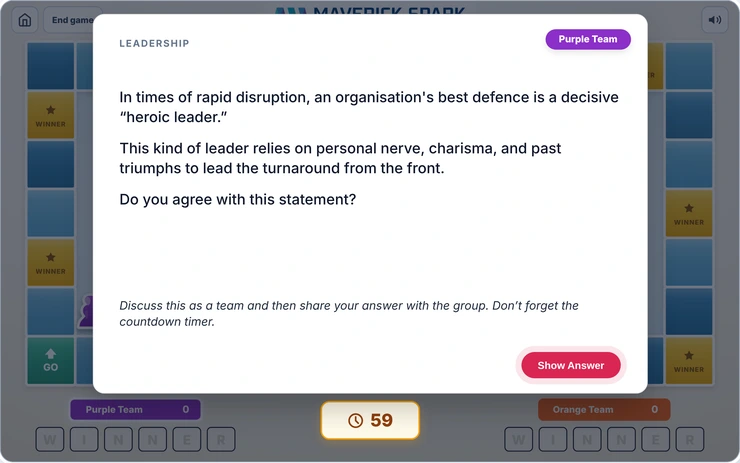
A team decision game in play: an open workplace scenario for the team to discuss, with team scores and a countdown timer

Andy Yeoman is our co-founder and serious game lead. Since 2004 he has developed over 150 different games, for organisations including:

NHS Roche McDonald's Bayer AstraZeneca UCB Heineken Pfizer BD PepsiCo Bristol Myers Squibb
Knowledge up from 69% to 85%
average score after short game
97% would recommend it
to colleagues after playing
Intention to act doubled
29.5% → 58.6% committed to act

Peer-reviewed studies of games Andy worked on (74 to 430 participants). References available on request.

Try a subject-specific demo.

These short demos show how games adapt to different subjects.
Every new game is built around your issues and objectives.

Team Decision Games

Workshop intensity. Simple delivery.

Turn meetings into focused, competitive discussions.

  • Audience: 4–20 people
  • Duration: 20–90 minutes
  • Format: In-person, online, hybrid
  • Tech: Any browser
  • Content: Built for your messages
Team collaborating around a scenario game screen

These games are usually played on a shared screen. They aren't designed for mobile phones.

Still not sure games belong at work?

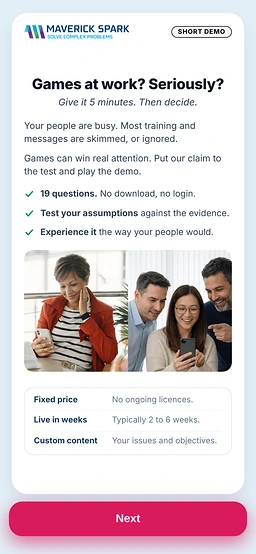
Games at work? Seriously? A 5-minute game that might change your mind.

Play the game
What you get back

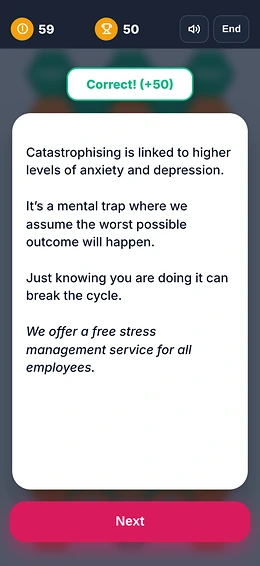
Players get instant feedback.
You get the evidence.

Every game feeds an aggregated dashboard. You can see where your message has got through, where it hasn’t, and what people plan to do next.

  • Knowledge gaps identified for targeted follow-up support
  • Aggregated audience sentiment and confidence tracking
  • Direct visibility into what actions players commit to taking
Audience dashboard Sample data
567participants
87%finished the game
9 minsaverage time spent
Knowledge by topic
Share of answers correct
Policy basics
91%
Data handling
88%
Spotting risks
84%
Reporting
78%
Escalation
62%
Gap found: target follow-up on Escalation
Confidence
Participants who feel confident
52%→81%
What people will do
Actions they commit to
Raise it with my manager
64%
Change how I work
38%
How It Works

From your issue to a live game in 2–6 weeks

We start with the problem, not the game.

1
Frame & map

We define the issue, profile your audiences and agree the outcomes.

2
Scenario design

Work with your experts to make your content effective in the game.

3
Build

Artwork, analytics and the game itself, using your branding.

4
Test & refine

Pilot with real users and adjust before anything goes live.

5
Launch & review

Launch the game and track impact through the dashboard.

FAQ

Development

What do you need from us?

The issue, your objectives, a description of the audience you want to reach, and any relevant material you already have: training, policies, comms, case studies. We write the scenarios, questions and answers from it, and your experts check them at agreed points.

How long does it take?

Usually 2 to 6 weeks from first conversation to live game. We start with a short scoping phase where we understand the nature of your issue, the availability of existing content and practical details about the audience. The main variable is often how quickly your reviewers can turn content round.

Can it use our branding and language?

Yes, we can use your branding. Other languages can be added as an extra.

Can we change the content after launch?

Yes. Questions and answers can be updated, added or retired as your issue moves on. The game’s database can hold a library of scenarios divided by difficulty, role and subject. We make the changes to content on your behalf, so the game keeps working as intended.

Data

What data do you collect?

Answers, scores, time spent and questionnaire responses. That is what feeds your dashboard.

Can we have the raw data?

Yes. Download it from the dashboard as a CSV file for your own analysis.

Who owns the content and data?

You own the content we create for you and all the data your players generate, and we never reuse your content for another client. We keep ownership of our background IP: the game engine, mechanics and design methods.

What about GDPR and player privacy?

Our standard games don’t ask players for any personal details: no names, emails or logins. If you add them, for example by asking for names or running the game through your learning platform, we handle that data under UK GDPR and sign a data processing agreement.

Hosting and access

What do players need?

A web browser on any device. They open a link or scan a QR code: one click, no download, no login. Bite-sized games are designed primarily for phones but will work on any device. Team games run on larger screens, in a meeting room or shared online.

Does our IT team need to install anything?

No. We host the game and give you a link to share by email, intranet, learning platform or QR code. Some firewalls need the address adding to an allowed list.

Where is it hosted?

We host it for you on secure cloud hosting, managed and kept up to date. The first 12 months are included in the price. If you’d rather run it on your own servers or intranet, we can arrange that, at extra cost.

Can it run in our learning platform (LMS)?

Yes. You can link to it from any platform, and that’s free. At extra cost, we can also supply it as a SCORM package, so your learning platform records completion and scores alongside your other courses.

Can it be a native app?

Most clients don’t need one, because games already work through a browser. If you want it in the Apple or Google app stores, or installed on company devices, we can turn it into a native app at extra cost.

Pricing

How much does a game cost?

Each game has a fixed price, agreed before we start. It depends on the format, the number of questions and any extras, such as other languages. Prices start below £10,000 plus VAT.

Are there licence fees?

No per-player or annual licence fees. The fixed price includes 12 months of hosting and maintenance. After that, a modest monthly fee keeps the game live.

What if our budget is tight this year?

We can split the price into an upfront payment and a fixed number of monthly instalments.